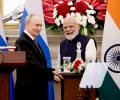
India and Russia have solidified a five-year plan to enhance their economic and trade partnership, while also addressing the ongoing conflict in Ukraine and the threat of terrorism.

The clock on the ceasefire is running out. But everyone's already whispering about round two, possibly as soon as this weekend.

Egypt, Pakistan, Saudi Arabia and Turkey met in Islamabad in what analysts say is the formal opening of a new diplomatic formation that could reshape the post-war regional order. Their immediate goal is a ceasefire; their larger ambition is to ensure that neither Iran nor Israel emerges from this war in a dominant position. Pakistan's foreign minister then flew directly to Beijing and mooted a Chinese role as guarantor of any eventual agreement. Prem Panicker continues his must read daily blog on the Gulf War.
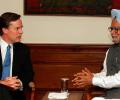
The India-US nuclear deal was aimed at ending India's nuclear isolation and nuclear apartheid, recalls Rup Narayan Das.

India and Israel have elevated their relationship to a special strategic partnership, focusing on enhanced cooperation in trade, technology, and defense, while also addressing regional peace initiatives.

India on Tuesday said cooperation in peaceful uses of nuclear technology is an important pillar of the multifaceted cooperation with Russia, which offered help in building small tropical nuclear power stations.

'Was the five-day pause ever meant to hold, or was it simply another instrument of signaling, of positioning, of buying time in a war where even the pauses are tactical?' asks Prem Panicker in his must read daily blog on the Gulf War.

Russian President Vladimir Putin will make a two-day visit to India from December 4 to hold annual summit talks with Prime Minister Narendra Modi that is expected to produce a plethora of significant outcomes, including in the defence sphere, to further solidify the bilateral strategic ties.

Iran is fighting a different war: Older, slower, and in some ways more dangerous. Iran doesn't need to shoot down an F/A-18. It only needs to make the Strait of Hormuz feel dangerous long enough for insurance markets, shipping companies, and oil futures traders to do the rest. Prem Panicker continues his must-read daily blog on the war in the Middle East.

The pause gives the US time to breathe, to regroup, to move its expeditionary force into position without risk of interception along the way. It gives Iran nothing -- on the ground, attacks against its infrastructure continue apace. Prem Panicker in his must read daily blog on the Gulf War.

Israel and the United States had a plan. Iran punched back. And now the Gulf is reeling, the world is beginning to feel the pain and, as on date, no one in Washington or Tel Aviv appears willing to admit that the punch has landed, notes Prem Panicker, continuing his must-read blog on the war in the Middle East.

On the table are additional batches of S-400 surface-to-air missile systems from Russia, which India used with immense success during Operation Sindoor. India could buy at least two squadrons of Su-57 fighter jets plus joint production of S-500 air defence systems.

In the Indo-Pacific's new era -- where perception shapes reality faster than treaties -- the real entrapment is not of China or the United States. It is the test Japan has set for itself -- and whether partners like India, acting as balancers rather than accelerants, can help ensure that the story ends in stability, points out Varun Arya.
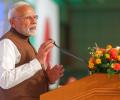
Showcasing India as an attractive investment destination, Modi said the country has political and economic stability as well as transparency and predictability in policy decisions.

Although the credit for acquiring the technological skill must be given to India's outstanding nuclear scientists, the decision to go nuclear was a political one that entailed clarity of vision, courage and resolve, points out Rup Narayan Das.
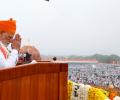
Prime Minister Narendra Modi addressed the nation on Independence Day, focusing on economic growth, self-reliance, and national security. He emphasized manufacturing quality products at affordable prices, supporting farmers, and combating terrorism and infiltration.

'Within 30 minutes of when Asim Munir made those comments, he should have been taken to Tampa airport and flown out of the United States.'

The exit of Larsen & Toubro (L&T) from the Hyderabad Metro is a long-term positive for the stock. It could be a bullish trigger, alongside higher international orders, and new opportunities in segments like defence and data centres.

A Pakistan that is more secure in its relations with the US is also one that might well wish to indulge in another cross-border misadventure.

'Pakistan is an ally who gives the US access.' 'If we have a presence there, it puts us that much closer to China and puts our assets closer to China and Iran.'

There is enough scope for India and China to cooperate on nuclear energy issues despite the lingering issues which not only includes the Sino-Pakistan nexus, but also the Sino-India border dispute over the LAC, says Debalina Ghoshal.

The nuclear issue is believed to have come up in context of the country's growing energy needs for which India is in the process of finalising an atomic agreement with the US.
The 123 agreement between the two former Cold War rivals was signed in Moscow by the Russian Atomic Energy Corporation Rosatom chief Sergei Kiriyenko and US ambassador William Burns. The civilian nuclear cooperation pact is a result of over 20 years of tough negotiations between the two countries and provides a legal framework for the nuclear trade between the companies of the two nations.
Budget 2025 lays down a transformational roadmap for India's digital and economic future, focusing on AI-driven enterprise modernisation, workforce skilling, and sustainable innovation. With bold investments in AI, digital infrastructure, and ease of doing business, the government has set the stage for businesses to scale, innovate and compete on a global level.

The deal would allow Japan to export nuclear technology to India, making it the first non-NPT signatory to have such a deal with Tokyo. It would also cement the bilateral economic and security ties as the two countries warm up to counter an assertive China.

During the talks with Prime Minister Narendra Modi, French President Francois Hollande reassured reliable, uninterrupted and continued access to nuclear fuel supply throughout the entire lifetime of the plants while acknowledging India's need for the same.
Backing Iran's right to peaceful uses of nuclear energy, India has said that "no country can put pressure" on Tehran in that respect as it sought establishment of strategic partnership with the oil-rich Persian country.
India and Russia today signed an agreement on civil nuclear cooperation with Prime Minister Manmohan Singh describing it as a "new milestone" in bilateral relations.
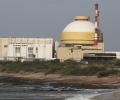
Owing to unfavourable weather conditions and for want of a barge the stator was not moved to Kudankulam earlier.
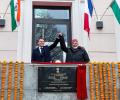
Prime Minister Narendra Modi and French President Emmanuel Macron have called for enhancing trade and investment ties between their countries and committed to further deepening their engagement in the Indo-Pacific. They discussed a full spectrum of bilateral relations, including key global and regional issues, and stressed the urgent need for reform in the United Nations Security Council. The leaders also underscored their commitment to ensuring the global AI sector can drive positive social, economic, and environmental outcomes.
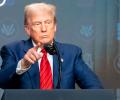
President Trump addresses questions about US imports from Russia and India's stance on purchasing Russian oil, hinting at potential tariffs.

The United States Department of Defence has announced that it will pursue a modern variant of the B61 nuclear gravity bomb, designated the B61-13, pending Congressional authorisation and appropriation.
Indicating a greater role of the private sector in the field of nuclear energy, Prime Minister Narendra Modi said there was a need to tap additional sources of investments for the ambitious expansion programme.

The deal would allow Japan to export nuclear technology to India.
China tacitly acknowledged on Thursday that it will build two new nuclear reactors in Pakistan in a deal that could re-ignite persistent concerns about proliferation and safety of atomic materials in the restive South Asian nation.

Modi praised the contribution of nuclear scientists in the successful implementation of India's three-stage nuclear programme.
Both countries have always supported the peaceful use of civil nuclear energy and an agreement in this connection is expected to be signed during the President's visit to China which began Tuesday, Ambassador Masood Khan said. The two countries will ink several agreements in the fields of technology, agriculture and minerals. They will also sign an investment protocol to their existing free trade agreement to boost investments in Pakistan, he told Geo News channel.
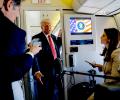
Two 'very smart' leaders of India and Pakistan decided to end last month's conflict that could have turned into a nuclear war, United States President Donald Trump said after holding a rare luncheon meeting with Pakistan army chief Field Marshal Asim Munir at the White House.

Modi will arrive in France on Thursday evening and straightaway head for talks with Macron, who will also host a working dinner for the visiting leader.
